

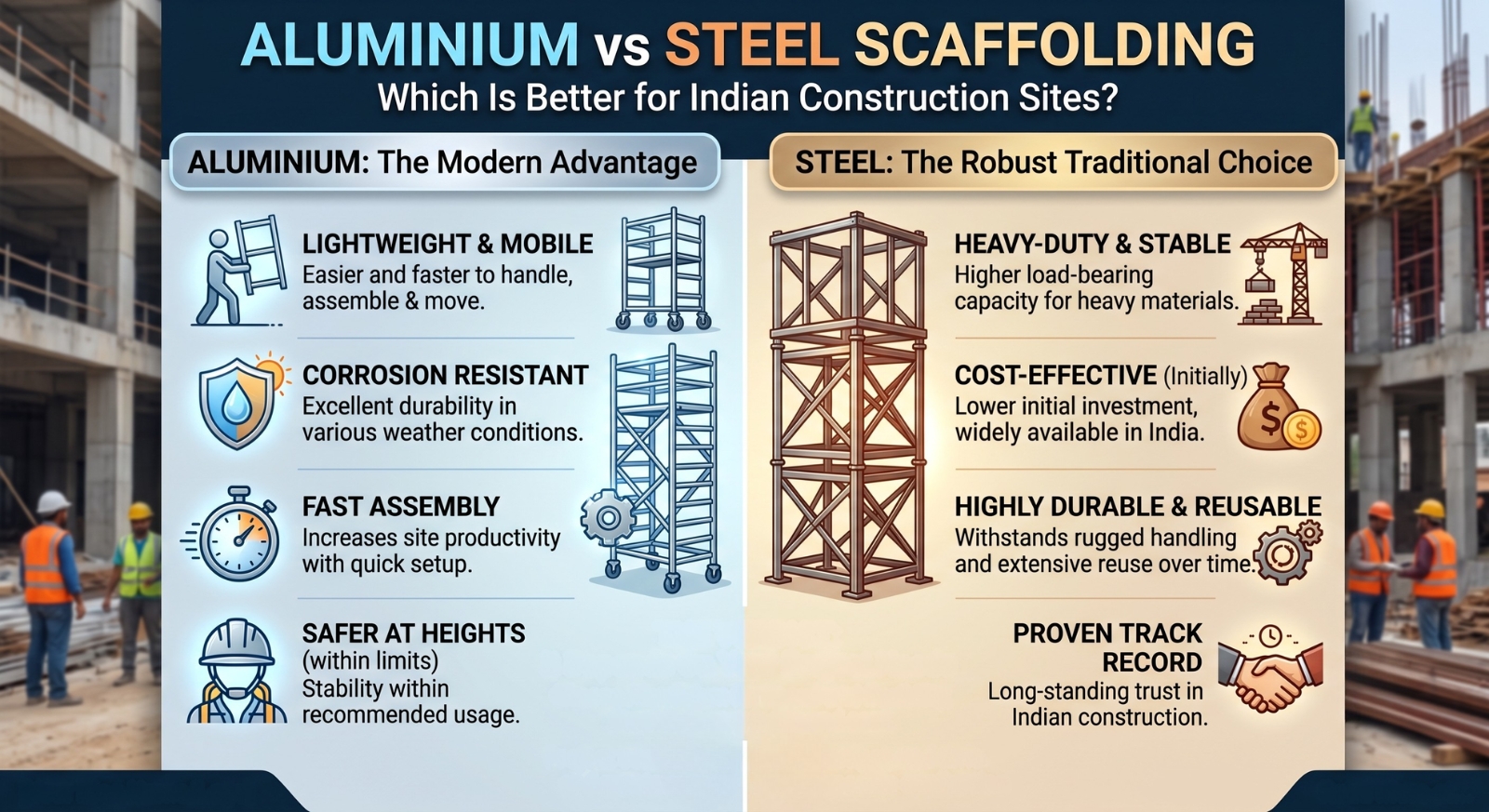
Aluminium scaffolding is better than steel scaffolding for most Indian construction sites in 2026. It is 60–70% lighter, assembles 3x faster, requires no tools, and delivers a lower total cost of ownership across the project lifecycle despite a higher upfront price. Steel scaffolding remains relevant only for extremely heavy-load, permanent, or large civil infrastructure projects where its higher load-bearing capacity is non-negotiable.
This guide breaks down every factor that matters to Indian contractors, builders, and facility managers, including weight, cost, safety, assembly, climate performance, and which specific project types call for each material. For the full picture, see our aluminium scaffolding buying guide.
Steel is stronger. Aluminium is smarter.
Steel scaffolding offers higher raw load capacity and a lower initial purchase price. Aluminium scaffolding is lighter, faster to assemble, corrosion-resistant, and more cost-effective across the full project lifecycle, especially on Indian sites where labour costs, monsoon weather, and multi-site mobility all play a critical role.
For the vast majority of Indian construction projects, residential buildings, commercial fit-outs, industrial maintenance, mall and airport work, painting and MEP installations, aluminium wins on almost every metric that determines real project cost.
This is where aluminium's advantage is most dramatic.
Aluminium is approximately 2.7 g/cm³ in density, compared to steel's 7.8 g/cm³. In practical terms, an aluminium scaffolding frame that weighs 15–25 kg would weigh 45–75 kg in steel — nearly three times as heavy.
What this means on an Indian construction site:
For maintenance contractors who work across multiple locations, such as malls, hospitals, warehouses, and airports, portability is not a luxury. It is the core operational requirement. Steel simply cannot compete here.
Indoor Innovations note: Our aluminium scaffolding systems have been supplied for working heights of over 100 feet, demonstrating that lightweight does not mean limited. Our towers are engineered with high-strength aluminium alloys and Gas Tungsten Arc Welding technology for maximum structural integrity at every height.
Assembly speed directly translates to project cost in Indian construction. Every additional day on site = additional labour, supervision, and overhead.
At an average Indian site labour rate of ₹600–800 per worker per day, the difference is substantial:
Task Aluminium Steel
Workers needed per tower 2 4–6
Assembly time (8m tower) 20–30 mins 2–4 hours
Labour cost per assembly ₹200–400 ₹1,200–3,200
Assemblies per project (estimate) 20 20
Total labour cost difference ₹4,000–8,000 ₹24,000–64,000
This is before accounting for reduced supervision time, faster project completion, and the ability to redeploy the same crew to multiple tasks in a single day.
This is where steel has a genuine, undeniable advantage.
Typical load ratings:
Type Load Capacity
Aluminium scaffolding (standard) 150–250 kg per platform level
Aluminium scaffolding (heavy duty) 450–750 kg per platform level
Steel tube-and-coupler scaffolding 500–2,000 kg per bay
Steel modular (Ringlock/Cuplock) 1,000–5,000 kg per bay
For projects involving:
Steel is the correct choice and a safety-critical one. Using aluminium scaffolding beyond its rated load capacity is a code violation and an unacceptable safety risk.
However, it is important to note that most scaffolding use cases in India, such as painting, MEP installation, facade work, ceiling work, interior fit-outs, maintenance, and inspection, operate well within aluminium's load rating. The perception that "steel can carry more, so it's better" often does not apply to the actual task at hand.
Indoor Innovations' aluminium scaffolding systems are rated to support 480 kg to 810 kg per platform, depending on configuration — sufficient for the vast majority of construction and maintenance applications.
India's climate presents a uniquely challenging environment for construction materials:
Steel scaffolding requires galvanisation or protective coating to resist corrosion. In Indian conditions:
Aluminium naturally forms a protective aluminium oxide layer on its surface when exposed to air. This layer:
Safety is non-negotiable. Indian construction sites are regulated under:
Both aluminium and steel scaffolding can comply with these standards, but the practical safety advantages of aluminium on Indian sites are significant:
1. Lighter load = fewer manual handling injuries. The most common construction site injuries in India involve manual handling of heavy materials. Aluminium's low weight directly reduces back injuries, crush injuries, and fatigue-related accidents.
2. Tool-free assembly = fewer assembly errors. Steel scaffolding that requires bolting and coupling is more vulnerable to assembly errors by less experienced workers. Aluminium pin-lock systems have fewer assembly steps and built-in error prevention.
3. No electrical conductivity advantage. This is a common myth that both aluminium and steel conduct electricity and are equally unsuitable for use near live electrical lines without appropriate insulation.
4. Non-slip platforms Quality aluminium scaffolding systems include non-slip aluminium deck platforms with integrated guardrails, toe boards, and access hatches, all designed for compliance with IS 3696.
Indoor Innovations' scaffolding systems are ISO 9001:2015 and ISO 45001:2018 certified, featuring secure locking mechanisms, non-slip platforms, guardrails, and adjustable base plates designed for full compliance with Indian and international safety standards.
Type Purchase Price Range
Aluminium mobile scaffolding tower (standard, 4–6m) ₹35,000–75,000
Aluminium stairway scaffolding tower (8–12m) ₹80,000–1,80,000
Steel tube-and-coupler scaffolding (per set) ₹20,000–45,000
Steel modular Cuplock system (per set) ₹30,000–60,000
Steel has a clear upfront price advantage. For a single-project contractor on a tight capital budget, this matters.
Type Monthly Rental Range
Aluminium mobile tower (4–6m) ₹4,800–21,000/month
Aluminium stairway tower (8–12m) ₹9,600–42,000/month
Steel scaffolding (basic frame, per floor) ₹6,000–16,000/month
For most Indian contractors and builders, renting is more cost-effective than buying, especially for projects under 6 months. Renting eliminates storage, maintenance, transport, and depreciation costs entirely.
The purchase price is only one part of the cost equation. Here is a realistic 5-year total cost comparison for a mid-sized Indian contractor running 8–10 projects per year:
Cost Factor Aluminium Steel
Purchase price (initial) ₹1,50,000 ₹80,000
Annual maintenance ₹5,000 ₹35,000
Labour cost (assembly/dismantling) ₹40,000/yr ₹1,20,000/yr
Transport cost (heavier steel = more trips) ₹20,000/yr ₹50,000/yr
Replacement due to corrosion (5 years) Nil ₹40,000
5-year total cost ₹3,75,000 ₹6,45,000
Aluminium costs 42% less over 5 years despite the higher purchase price, purely because of labour, maintenance, transport, and replacement cost savings.
This is the number every Indian contractor should have before deciding based on purchase price alone.
Construction and fit-out
Industrial and maintenance
Commercial and institutional
Infrastructure
With India's commitment to net zero by 2070 and growing ESG requirements from large developers and international clients, the environmental footprint of scaffolding is increasingly relevant.
Aluminium advantages:
Steel considerations:
For builders targeting IGBC Green Rating, LEED certification, or GRIHA rating, using ISO-certified aluminium scaffolding can contribute to materials efficiency and waste reduction credits.
Beyond the standard comparison, several India-specific realities make aluminium scaffolding particularly well-suited to Indian construction conditions:
1. Skilled labour shortage. India faces a chronic shortage of skilled construction workers. Aluminium's tool-free, intuitive assembly reduces dependence on specialist skills — any reasonably trained worker can erect a tower safely following basic instructions.
2. Multi-city project execution. Indian contractors increasingly operate across multiple cities simultaneously — Delhi, Ahmedabad, Hyderabad, Bangalore. Aluminium's portability makes it practical to transport scaffolding between cities by tempo or truck. Steel's weight often makes this economically unviable.
3. Urban site constraints. Most Indian urban construction sites are constrained — narrow lanes, basement parking areas with height restrictions, and shared compound walls. Aluminium towers can be broken down into compact components and carried through narrow spaces. Steel scaffolding often cannot.
4. Monsoon site shutdowns. Steel scaffolding left outdoors through the monsoon requires post-monsoon inspection, rust treatment, and potential replacement of degraded components. Aluminium requires nothing more than a rinse.
5. Hoardings and building facades in Delhi NCR. The National Green Tribunal and municipal authorities in Delhi have increasingly restricted dust-generating activities and required covered scaffolding systems. Aluminium's modular design makes it easier to integrate dust nets, shrink wrap coverings, and temporary hoarding attachments.
6. The 100+ft milestone. Indoor Innovations has supplied aluminium scaffolding for working heights of over 100 feet, demonstrating the material's capability for even the most demanding Indian infrastructure projects. This height would be impossible to achieve safely and cost-effectively with conventional steel tube-and-coupler systems.
Factor Aluminium Steel
Weight 60–70% lighter Heavy
Assembly speed 2 workers, 20–30 mins 4–6 workers, 2–4 hours
Tools required None Spanners, bolts
Load capacity 150–810 kg per platform 500–5,000+ kg per bay
Corrosion resistant Excellent (natural oxide layer) Requires galvanising/coating
Maintenance Minimal (cleaning only) Annual inspection + treatment
Upfront purchase cost Higher Lower
5-year total cost Lower Higher
Lifespan (India) 15–25 years 8–15 years
Portability Excellent Poor
Monsoon performance Unaffected Requires treatment
ISO certification available Yes Yes
Best for Most Indian projects Heavy civil infrastructure
Recyclability 100% High (more energy intensive)
For 90% of Indian construction, maintenance, and industrial projects: choose aluminium scaffolding.
The decision comes down to one question: what actual load do you need to carry on the platform?
If your workers need to stand, move, and use hand tools with aluminium handles, this is with a safety margin to spare, at significantly lower total cost and dramatically better site efficiency.
If you are placing precast concrete panels, storing brick pallets, or building the falsework for a bridge deck, you need steel's higher load capacity, and the additional weight and cost are justified.
For every other scenario, and that covers the vast majority of work done on Indian construction sites, aluminium scaffolding delivers better safety, faster completion, lower labour cost, and lower lifetime cost than steel.
Q: Is aluminium scaffolding safe for construction work in India?
Yes. Aluminium scaffolding certified to ISO 9001:2015 and IS 1831 is fully safe for Indian construction. It features guardrails, non-slip platforms, and locking mechanisms designed for compliance with IS 3696. The key is buying from an ISO-certified manufacturer and never exceeding the rated load capacity.
Q: What is the price difference between aluminium and steel scaffolding in India?
Aluminium scaffolding costs approximately 30–50% more to purchase upfront. However, across a 5-year lifecycle, aluminium typically costs 35–45% less than steel due to lower labour, maintenance, transport, and replacement costs.
Q: Can aluminium scaffolding be used during the monsoon season in India?
Yes — this is actually one of aluminium's strongest advantages. Aluminium does not rust or corrode, so it performs identically in monsoon conditions as in dry weather. Steel scaffolding requires post-monsoon inspection and anti-rust treatment.
Q: What is the maximum height achievable with aluminium scaffolding in India?
Indoor Innovations has supplied towers for working heights of over 100 feet. Standard freestanding towers reach 8–12 metres. With stabilisers and ties to the building structure, heights of 50m+ are achievable with engineered systems.
Q: Is it better to buy or rent aluminium scaffolding in India?
For project-based contractors, renting is almost always more cost-effective than buying. Renting eliminates capital outlay, storage, maintenance, and depreciation. For contractors with consistent, ongoing scaffolding needs across multiple projects, purchasing becomes viable after 18–24 months of regular use.
Q: Which scaffolding is better for interior work — aluminium or steel?
Aluminium is significantly better for interior work. Its lighter weight protects finished flooring, its tool-free assembly avoids damage from dropped tools, and its compact design navigates through doorways and narrow corridors that steel scaffolding cannot access.
Q: Does aluminium scaffolding comply with Indian safety standards?
Yes. Quality aluminium scaffolding must comply with IS 1831 (aluminium alloy scaffolding specification) and IS 3696 (scaffolding safety code). Additionally, ISO 9001:2015 and ISO 45001:2018 certifications provide international assurance of quality and occupational safety.
Q: Can one person assemble aluminium scaffolding?
Most manufacturers recommend a minimum of two people for safe assembly. However, the lightweight nature of aluminium means that a competent two-person team can safely erect towers up to 8–10 metres without mechanical assistance.
About Indoor Innovations: We are India's ISO 9001:2015 and ISO 45001:2018 certified aluminium scaffolding manufacturer and supplier, with offices in Delhi, Panipat (Haryana), Ahmedabad, Hyderabad, and Bangalore. We have delivered scaffolding solutions to over 500+ projects, including Adani, Reliance, Samsung, Siemens, Godrej Properties, and M3M. Our aluminium scaffolding is available for rent and sale, pan-India. Contact us at +91-9811341384 or Request a Quote.
Related reading: why aluminium scaffolding is the best investment for Indian contractors.
© All Rights Reserved by Indoor Innovations LLP


