

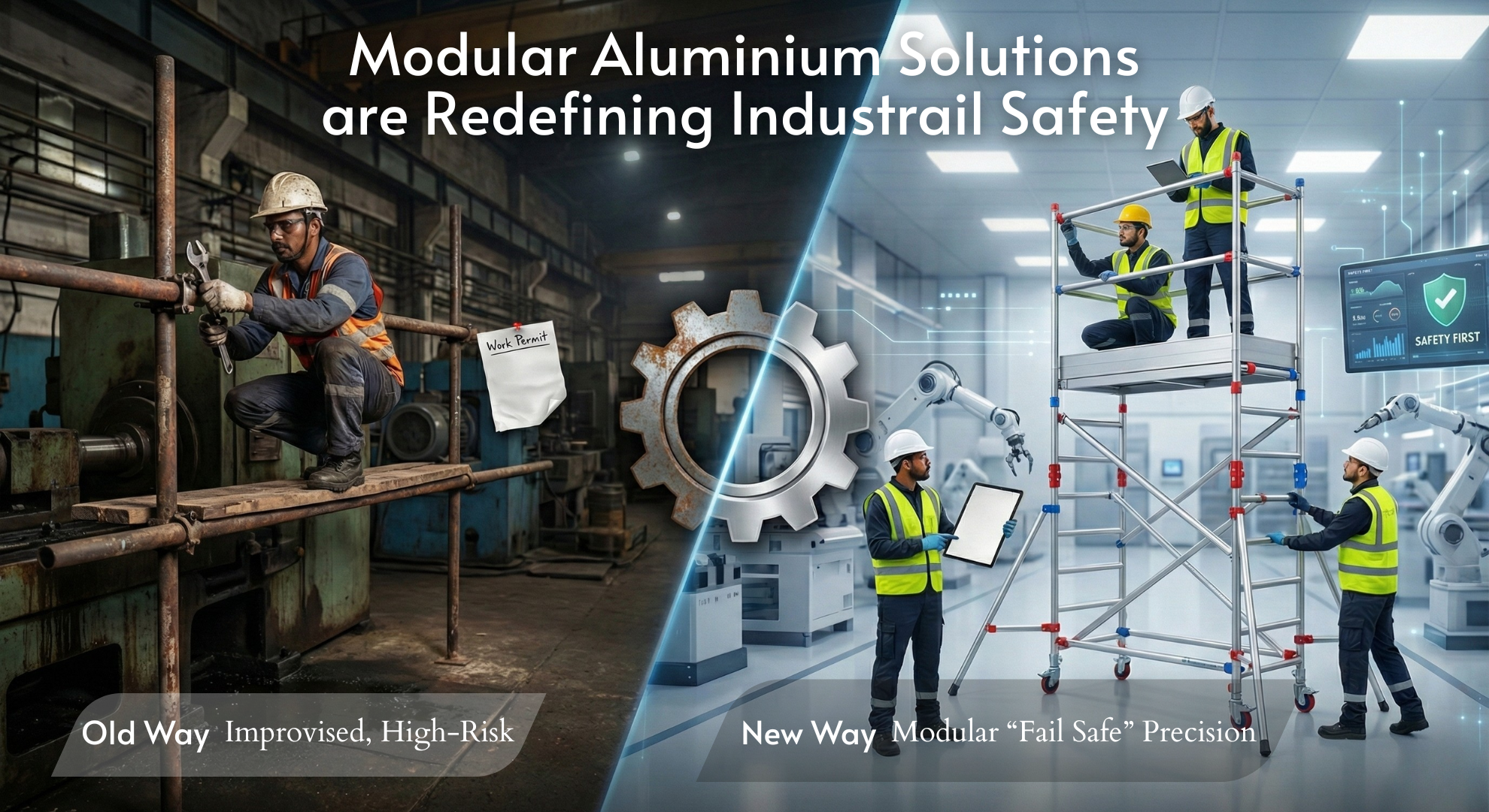
The "Industrial Revolution 4.0" in India is not just about robots and AI; it is about smarter, safer ways of performing manual tasks. In the manufacturing, pharmaceutical, and automotive sectors, the old ways of "making do" with heavy, improvised scaffolding are being replaced by high-precision, modular solutions. Aluminium Scaffolding by Indoor Innovations is at the forefront of this movement, providing industrial teams with "Fail-Safe" access that prioritizes the worker’s life above all else.
The core of "Maintenance 4.0" is Modularity. Traditional "pipe and clamp" scaffolding relies heavily on the skill and memory of the person assembling it. If a clamp isn't tightened enough or a brace is missed, the entire structure is compromised. In contrast, modular aluminium systems are engineered with interlocking snap-locks and colour-coded components. These systems are designed so that pieces can only fit together in one way—the safe way. This "poka-yoke" (error-proofing) design significantly reduces the risk of human error, which is the leading cause of scaffolding failures in Indian factories.
In an industrial setting, the "Strength-to-Weight" ratio is critical. Maintenance often involves heavy tools, specialised machinery, and multiple technicians on a single platform. There is a common misconception that because aluminium is light, it is "weak." However, the high-grade alloys used by Indoor Innovations are designed to handle heavy industrial loads while remaining light enough to be moved by hand. This portability is essential during "Plant Shutdowns" or "Turnarounds," where maintenance teams must move quickly from one machine to another. A mobile aluminium tower can be wheeled into position, locked down, and put to work in a fraction of the time it takes to build a static structure.
Finally, modern industrial safety requires a data-driven approach to risk. By using standardised, certified aluminium equipment, safety officers can more accurately complete their Hazard Identification and Risk Assessments (HIRA). They no longer have to guess the load capacity of a rusted steel pipe or a worn wooden plank. With Indoor Innovations, every component has a known, tested capacity. This level of predictability allows for a more robust "Permit-to-Work" system and fosters a genuine "Safety First" culture within the factory. As the Indian industry continues to modernise, the transition to modular aluminium solutions is becoming the hallmark of a world-class manufacturing facility.
© All Rights Reserved by Indoor Innovations


