

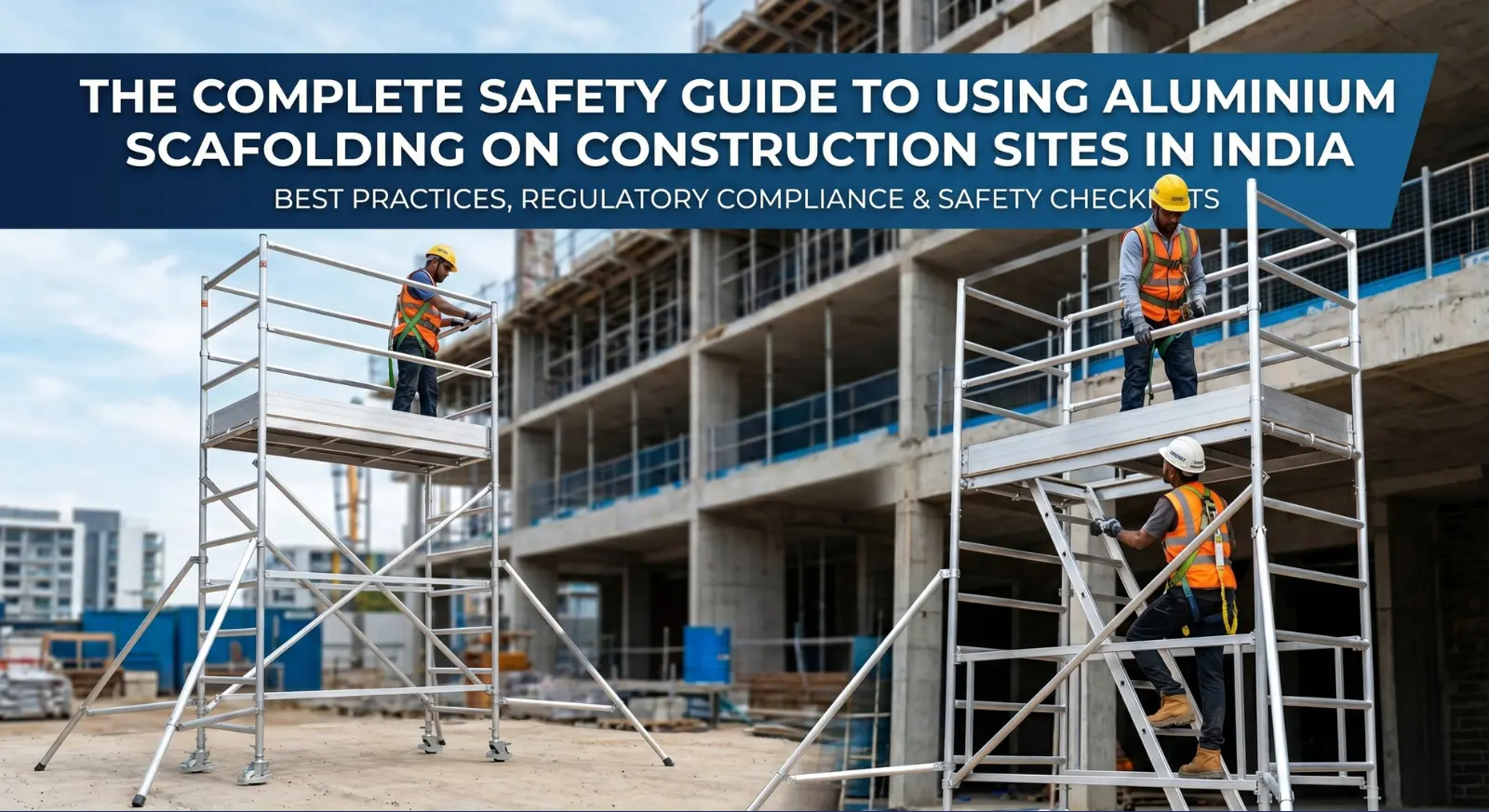
Worker safety on Indian construction sites has come under increasing regulatory and public scrutiny in recent years. Falls from height remain one of the leading causes of construction site fatalities in India, and improper use of scaffolding is a major contributing factor. Whether you are a site manager, safety officer, contractor, or worker, understanding how to use aluminium scaffolding safely is not optional. It is a legal obligation and a professional responsibility.
This guide covers everything you need to know about safe aluminium scaffolding use on Indian construction sites, from assembly and inspection to load management and emergency procedures. Browse our certified aluminium scaffolding range to see systems built for compliance.
Construction site safety in India is governed by the Building and Other Construction Workers (Regulation of Employment and Conditions of Service) Act 1996 and the associated Building and Other Construction Workers (RE&CS) Central Rules 1998. These regulations impose specific obligations on construction employers regarding scaffolding safety, including mandatory inspection before use, load capacity marking, trained assembly personnel, and fall protection requirements.
,The Bureau of Indian Standards (BIS) and international standards including EN 1004 and ISO 9001-2015, provide additional technical benchmarks for scaffolding design and performance. Indoor Innovations aluminium scaffolding meets EN 1004 standards and is manufactured under ISO 9001-2015 quality management, providing a strong compliance foundation for contractors using our systems.
Safe scaffolding use begins before the first component is lifted. A thorough site assessment should cover the following.
Ground conditions are critical. Aluminium scaffolding must be erected on firm, level ground capable of supporting the combined weight of the tower, workers, tools, and materials. Soft ground, slopes, or surfaces with loose material require stabilisation or levelling before tower erection. Our adjustable legs accommodate minor unevenness but cannot compensate for significantly sloped or unstable surfaces.
Overhead hazards must be identified. Electricity lines, ceiling structures, overhead machinery, and structural elements must be mapped before assembly. Minimum clearances from live electricity lines must be maintained at all times.
Working space must be adequate. The tower footprint plus outriggers requires sufficient clear space. Passageways and emergency exits must remain unobstructed. Vehicle and equipment movement paths must be identified and kept clear of the scaffolding zone.
Indoor Innovations aluminium scaffolding uses a tool-free assembly system that significantly reduces assembly errors compared to traditional tube-and-coupler systems. However, the correct assembly sequence is essential for structural integrity. Always follow the manufacturer's assembly sequence. Components must be assembled in the correct order, with all snap connections fully engaged, before adding height. Never skip components or improvise with non-standard parts. All brace hooks must fully snap into position; a partial connection can fail under load.
Castor wheels must be locked before any worker climbs the tower. All four wheels must be engaged simultaneously; a tower with even one unlocked wheel is unsafe.
Outriggers must be deployed at the specified heights according to the assembly manual. Indoor Innovations towers require outriggers beyond certain heights; bypassing this requirement to save time is a leading cause of scaffolding collapse.
Guardrails must be installed on all open sides and ends of every working platform. Toe boards must be fitted to prevent tools and materials from falling onto workers below. Never extend a tower beyond its rated maximum working height. Indoor Innovations provides clear specifications for each tower type; these limits are structural and must not be exceeded.
Every scaffolding platform has a rated load capacity, the maximum combined weight of workers, tools, and materials it can safely support. Indoor Innovations aluminium scaffolding platforms are rated for working loads of up to 200 kg/m² with platform-specific capacities ranging from 480 kg to 810 kg, depending on the tower model.
Common load management mistakes on Indian construction sites include placing heavy material loads on platforms without checking capacity, allowing too many workers on the platform simultaneously, and using the platform as a material storage area. At the same time, work is being performed, and adding non-standard extensions or platforms that increase load beyond rated capacity.
A simple rule: if in doubt, reduce the load. No time saved by overloading a platform is worth the risk of catastrophic failure.
Every aluminium scaffolding tower must be inspected before each use by a competent person. The inspection should cover the following checklist.
All snap connections and interlock clips must be fully engaged. Castor wheels must be functional, and locking brakes must hold. Outriggers must be correctly deployed and secured. Guardrails must be in place on all open sides. Toe boards must be fitted. The platform surface must be clear of loose materials, oil, water, or debris that could cause slipping. The tower must be vertical; any lean greater than 1:200 should be investigated and corrected before use.
Any damaged, bent, or corroded component must be removed from service immediately and replaced with a genuine manufacturer part. Never use improvised repairs on structural scaffolding components.
Workers using aluminium scaffolding platforms should follow these practices at all times. Always maintain three points of contact when climbing: two hands and one foot, or two feet and one hand. Never carry materials while climbing. Use a materials bucket, hoist, or have a colleague hand materials up once you are safely on the platform. Never lean beyond the guardrail to reach a work area. If you cannot reach it safely from the platform, reposition the tower. Never stand on the guardrail or toe board. Never use improvised extension boxes, ladders, or chairs to gain additional height from the platform. Always descend the tower before repositioning it. Never move a tower with workers on the platform, even for short distances. All workers must dismount, all tools and materials must be removed, and all castor wheel brakes must be released before the tower is moved.
The Building and Other Construction Workers Act requires that workers engaged in scaffold erection and dismantling be adequately trained. Indoor Innovations provides on-site assembly training with every scaffolding purchase, covering correct assembly sequence, load management, inspection procedures, and emergency protocols. Site managers are responsible for ensuring that all workers who use scaffolding platforms have received adequate safety briefing, even if they are not involved in assembly. The hazards of working at height, correct climbing technique, and emergency evacuation procedures must be communicated to every worker before first use.
Every construction site should have documented emergency procedures for scaffolding incidents, including tower instability, component failure, worker fall, and medical emergency at height. Emergency evacuation routes from elevated platforms must be identified and communicated to all workers. First aid equipment must be accessible at ground level. Emergency contacts, including the site safety officer, medical emergency, and scaffolding manufacturer, must be posted at the site entrance. If a tower shows any signs of instability, unusual movement, creaking sounds, or visible deflection, all workers must evacuate immediately. The tower must be taken out of service and inspected by a qualified person before returning to use.
Aluminium scaffolding is among the safest access equipment available for Indian construction sites, but only when assembled correctly, used within rated capacities, and maintained properly. The investment in proper training, regular inspection, and certified equipment pays for itself many times over in avoided accidents, project continuity, and regulatory compliance.
Indoor Innovations provides full assembly training, safety documentation, and after-sales support for all scaffolding purchases across India.
📞 +91-9811341384 | sales.scaffolding@indoorinnovations.in
Related reading: the 10-point checklist for renting aluminium scaffolding.
© All Rights Reserved by Indoor Innovations LLP


