

Renting aluminium scaffolding looks simple until a delivery shows up with corroded couplers, no test certificate, and a height rating that doesn't match what you booked. On a live site, that's not an inconvenience; it's a stop-work order waiting to happen, and in the worst case, a fall.
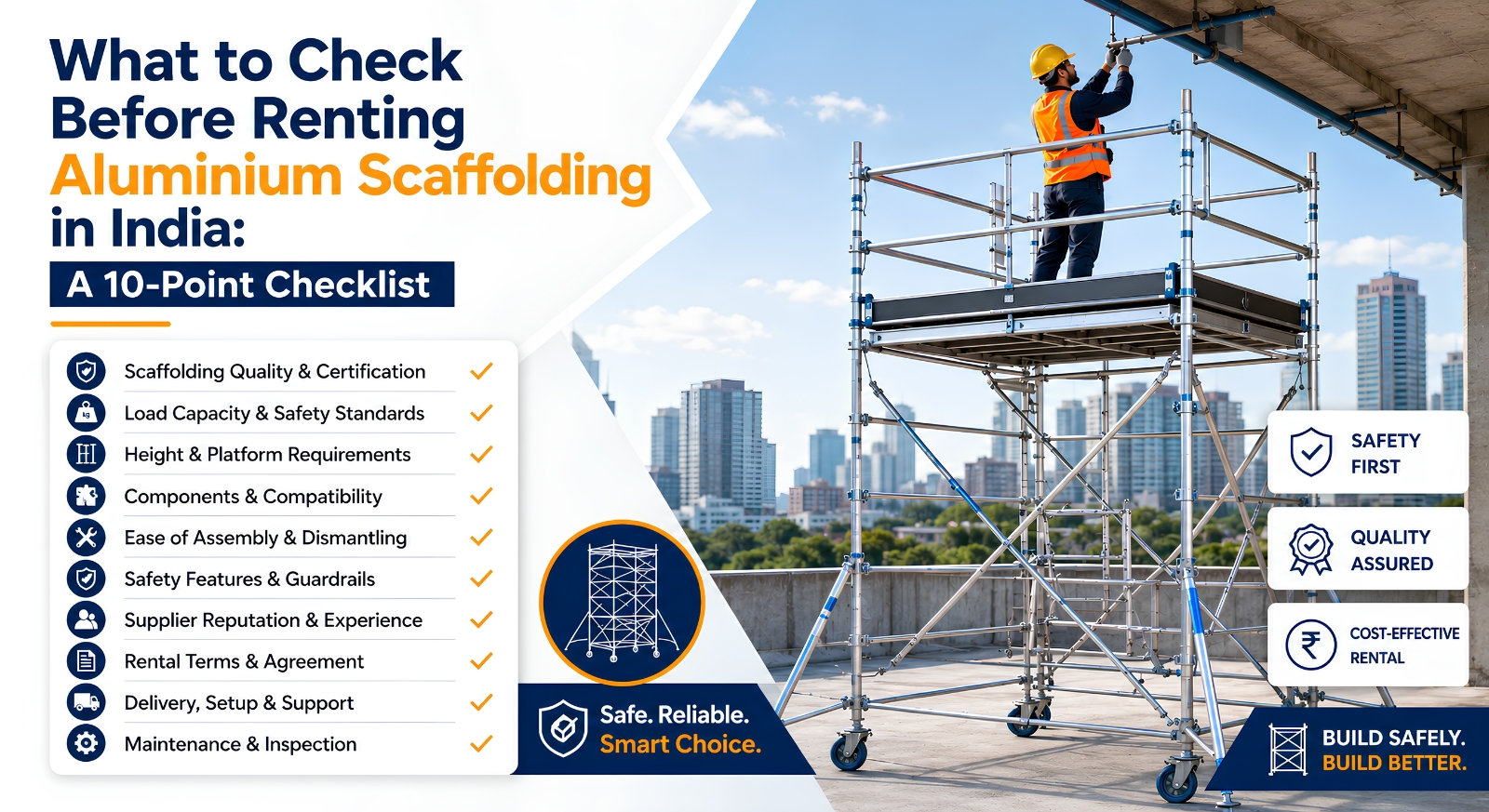
This checklist covers exactly what to inspect, ask for, and confirm before you sign a rental agreement or accept a delivery. Whether you're a site manager hiring a mobile tower for a single fit-out or a contractor sourcing scaffolding across multiple projects, run through these ten points every time.
Now, the details behind each one.
Aluminium scaffolding is only as good as the alloy it's made from. Look for a named, heat-treated structural grade — Indoor Innovations towers use 6063-T6 aluminium, which has the strength-to-weight ratio that scaffolding depends on. Cheaper rental stock is sometimes made from unmarked or recycled alloy that looks identical but fails under load. Ask for the mill test certificate and check it names the grade, e.g. 6063-T6 or an equivalent structural grade.
What to check:
Red flag: A supplier who can't tell you the alloy grade, or says "it's all the same aluminium." It isn't.
Every scaffold has a rated platform load, usually expressed in kg per platform or kg/m². Using a light-duty tower for masonry or heavy material storage is one of the most common causes of structural failure on-site.
Duty classes you'll encounter:
Duty Class Typical Load Common Use
Light duty ~150 kg/platform Inspection, light maintenance, painting
Medium duty ~250 kg/platform General trades, electrical, plumbing
Heavy-duty 350 kg+/platform Masonry, plastering, material-heavy work
What to check:
A scaffold safe at 4 metres, tied to a building, may be unsafe at the same height when free-standing. The critical figure is the base-to-height ratio, which determines how tall the tower can go relative to its base width before it needs outriggers or tying-in.
What to check:
Rule of thumb: Indoor free-standing towers are commonly limited to a height roughly 3.5x the minimum base dimension; outdoor towers are less. Always confirm the manufacturer's figure rather than relying on the rule.
On mobile towers, the castors (wheels) are where most accidents start. A brake that doesn't fully engage means a tower can roll while someone's working at height.
What to check on delivery: physically test these:
Red flag: Worn brake pads, missing locking pins, or castors that spin freely with the brake "on."
Edge protection is non-negotiable. A working platform without proper guardrails and toe boards is a fall and a falling-object hazard at the same time.
What to check:
Walk the platform before anyone works on it. If it flexes alarmingly or a board rattles loose, reject it.
This is where AEO-style "how do I choose a supplier" questions get their real answer: demand a named standard. In India, the relevant references are IS 4014 (steel scaffolding code, widely referenced for general scaffold safety practice) and the international EN 1004 standard specifically for mobile access towers, which most quality aluminium tower manufacturers build to.
What to check:
Red flag: "We don't really follow a standard, it's just standard scaffolding." Walk away.
A reputable rental supplier maintains documentation. You should be able to see it.
What to ask for:
For your own protection, log your own inspection on the day of delivery and before first use, and re-inspect after any modification, adverse weather, or if the tower has been moved.
The commercial fine print decides who pays when something goes wrong. Read it before, not after.
What to confirm in the agreement:
Get the component list and condition noted on the delivery docket so you're not charged for damage that arrived with the unit.
Anyone can list scaffolding for hire. Fewer can support you when a tower's short a brace at 7 a.m. on a deadline.
What to evaluate:
A supplier with multiple branches and in-house manufacturing can usually swap out faulty equipment same-day — a real difference when downtime costs you a crew's wages.
Rental of equipment is not the same as insurance for how it's used. Clarify the boundary.
What to check:
Confirm your own contractor's all-risk or public liability policy covers work at height with rented access equipment.
What standard should aluminium scaffolding meet in India?
For mobile aluminium access towers, EN 1004 is the most relevant quality standard, while IS 4014 is the widely referenced Indian code for scaffolding safety practice. Always ask the supplier to state the standard in writing.
Is aluminium scaffolding better than steel for rental?
Aluminium is lighter, faster to assemble, corrosion-resistant, and ideal for mobile towers and indoor work. Steel is typically chosen for very heavy-duty, long-term static scaffolding. For most maintenance, fit-out, and access work, aluminium towers are the practical rental choice.
How tall can a free-standing aluminium tower go?
It depends on the base width and whether stabilisers are fitted. Indoor free-standing towers commonly reach a height of around 3.5 times the minimum base dimension; outdoor towers are limited further by wind. Always confirm the manufacturer's rated maximum rather than estimating.
Who is responsible if a rented scaffold fails on site?
Equipment defects generally sit with the supplier; incorrect assembly, misuse, and skipped inspections sit with the hirer. Read the indemnity clause and confirm your own work-at-height insurance.
How often should rented scaffolding be inspected?
Before first use, after any modification or relocation, after adverse weather, and at regular intervals during the hire. The supplier should also provide a pre-delivery inspection record.
Need aluminium scaffolding you can verify on all ten points? Indoor Innovations manufactures and supplies ISO-certified aluminium scaffolding across Delhi, Haryana, Ahmedabad, Hyderabad, and Bangalore — with documentation, on-site support, and same-region stock.
Related reading: aluminium scaffolding price in India 2026.
© All Rights Reserved by Indoor Innovations LLP


