

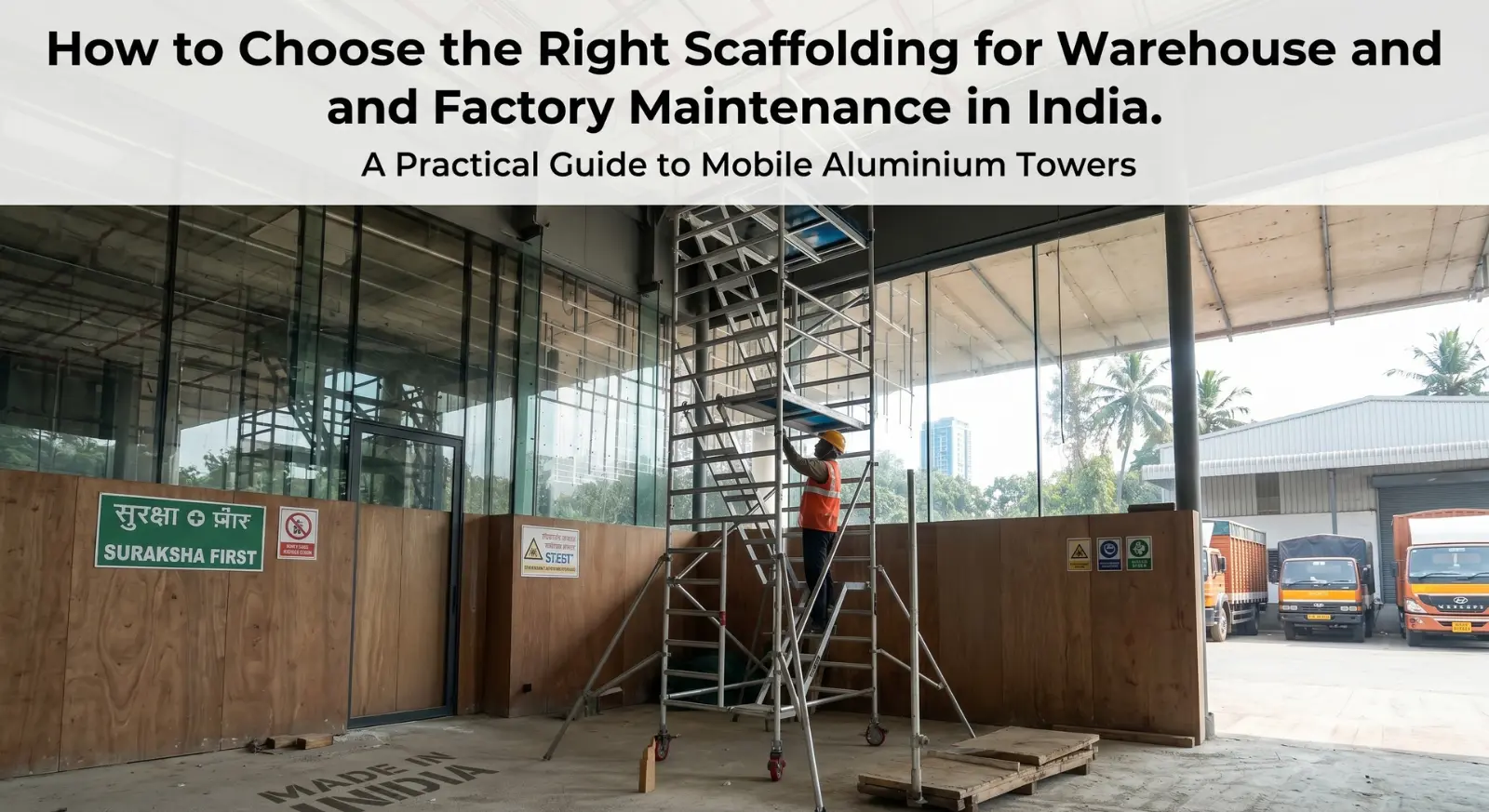
Warehouses and factories across India face a common challenge: how do you safely and efficiently maintain facilities that have high ceilings, complex equipment layouts, and continuous operations without disrupting production or compromising worker safety?
For facility managers and maintenance teams across India's industrial belt from Gurugram and Faridabad to Pune, Ahmedabad, and Hyderabad, aluminium scaffolding has become the access solution of choice. This guide explains why, and how to choose the right scaffolding system for your specific facility.
Industrial facilities present access challenges that are fundamentally different from construction sites. In a construction environment, scaffolding is typically erected once and used for an extended period. In a warehouse or factory, maintenance access is frequent, varied, and often urgent a lighting failure needs fixing today, a conveyor belt needs inspection this week, a roof panel needs replacement before the monsoon.
This means industrial maintenance scaffolding must prioritise mobility and speed of repositioning above all else. The tower that takes an hour to move is a tower that delays maintenance, reduces productivity, and increases the temptation for workers to improvise unsafe alternatives.
Additionally, industrial facilities are typically occupied and operational during maintenance. This means the scaffolding must have a minimal footprint, must not obstruct movement of forklifts, vehicles, and personnel, and must not create secondary hazards for workers on the ground.
Steel scaffolding, the traditional alternative, fails on almost every criterion for industrial maintenance use. It is heavy, requiring significant manpower and often mechanical assistance to move. It corrodes in humid environments, including cold storage facilities, food processing plants, and coastal industrial areas. It produces sparks when struck, a serious hazard in environments with flammable materials or gases. It is magnetically incompatible with environments containing sensitive electronic equipment or MRI machines in medical facilities.
Aluminium scaffolding addresses all of these issues simultaneously. It is 65% lighter than steel, movable by two workers without mechanical assistance. It is naturally corrosion-resistant, requiring no treatment even in high-humidity environments. It is non-sparking and safe for use in paint shops, chemical storage areas, and fuel handling facilities. It is non-magnetic and safe for use near electrical substations, server rooms, and medical imaging equipment.
For Indian industrial facilities operating in monsoon-affected climates and humid storage environments, the corrosion resistance advantage alone justifies the choice of aluminium over steel.
Indoor Innovations supplies six aluminium scaffolding tower types. Here is how to match them to specific industrial maintenance applications.
If your maintenance team needs to climb the scaffolding multiple times per day for lighting rounds, equipment checks, painting, or inspection, stairway scaffolding is the right choice. The integrated stair flight provides a much safer and less fatiguing climbing experience than ladder-access towers for frequent use. Working heights from 4.4m to 18.4m cover the vast majority of industrial facility ceiling heights in India.
Best for: lighting maintenance, HVAC servicing, roof inspection access, and regular equipment checks at height.
India's older industrial facilities and warehouses often have tightly packed equipment layouts with limited access corridors between machinery. Our narrow scaffolding at just 0.75m wide can access spaces that wider towers simply cannot enter. Working heights from 3.2m to 13.3m cover most internal access requirements.
and Best for: maintenance between machinery, access in congested production areas, work in aisles and corridors, internal facility painting.
When maintenance is required directly above fixed equipment conveyor belts, production lines, or large machinery, repositioning the machinery to allow scaffolding access is often impractical or impossible. Cantilever scaffolding provides horizontal reach over the obstruction, allowing work above the equipment without moving it.
Best for: maintenance above conveyor systems, work above fixed production machinery, and access above racking systems.
When maintenance spans a large area, roof panel replacement, painting of a large ceiling section, and installation of overhead infrastructure bridge-type scaffolding allows two towers to be connected with spanning bridge platforms of 2.5m to 6m. This allows work across a wide area without repositioning individual towers for every metre of progress.
Best for: large-area ceiling work, roof panel maintenance, overhead infrastructure installation, and facility-wide painting projects.
India's modern logistics and e-commerce warehouses increasingly feature ceiling heights of 12m, 15m, or even higher, far beyond the reach of standard scaffolding. Our extra approachable towers reach working heights from 14.4m to 36.4m (over 100 feet), covering even the tallest industrial structures.
Best for: maintenance in high-bay warehouses, tall industrial chimneys and silos, high-clearance manufacturing facilities, large-span industrial sheds.
Before contacting Indoor Innovations for a scaffolding quote, gathering the following information will help us recommend the right system and provide an accurate quotation.
Maximum working height required — measure from the floor to the highest maintenance point, then add approximately 2m for a comfortable working posture. Minimum aisle or corridor width — this determines whether standard or narrow towers are required. The number of simultaneous access points determines how many towers are needed. Frequency of maintenance — monthly, weekly, or daily use patterns affect the rent vs buy calculation significantly. Specific access challenges — machinery that cannot be moved, overhead obstructions, and floor surface conditions.
For facilities with ongoing monthly maintenance requirements, purchasing aluminium scaffolding almost always delivers better value than renting. The calculation is straightforward if you need scaffolding for more than 4-5 months per year; annual rental costs will exceed the purchase price, meaning you are effectively paying for the equipment multiple times without owning it.
Indoor Innovations offers direct-from-manufacturer pricing for scaffolding purchases across India. For facilities with irregular or seasonal maintenance requirements, we also offer flexible rental terms with delivery and assembly across North India.
The right aluminium scaffolding system transforms industrial maintenance from a slow, hazardous, logistics-intensive process into a fast, safe, and efficient operation. The investment in the right equipment pays for itself rapidly in reduced maintenance time, improved worker safety, and lower long-term costs.
Contact Indoor Innovations to discuss the best aluminium scaffolding solution for your warehouse or factory maintenance requirements.
📞 +91-9811341384 | sales.scaffolding@indoorinnovations.in
Related reading: choosing the right aluminium scaffolding for your project.
© All Rights Reserved by Indoor Innovations LLP


