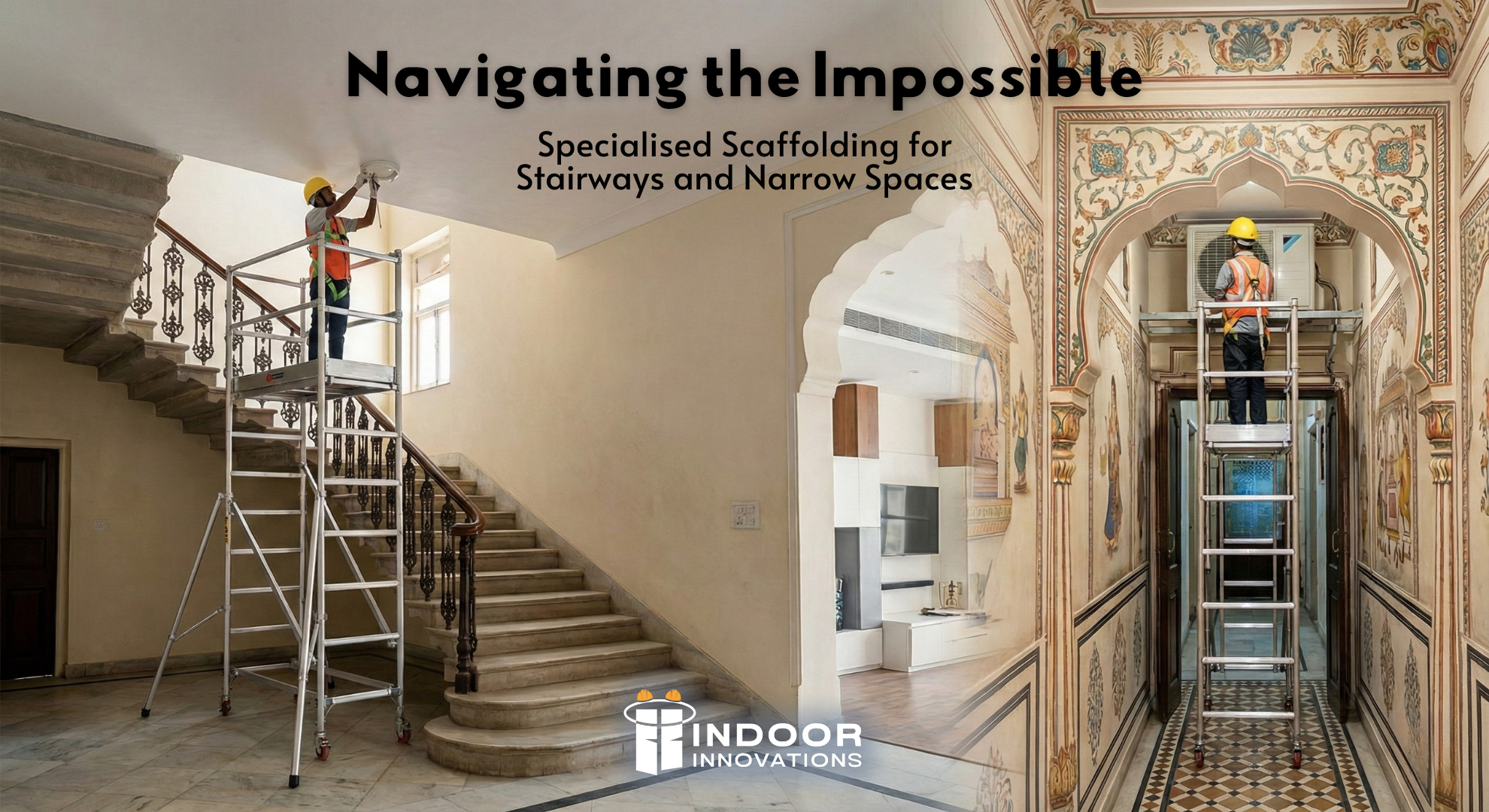
Aluminium mobile scaffolding is a lightweight tower of aluminium frames and braces on lockable castor wheels, built to give a safe working platform that one team can wheel from one spot to the next. It suits jobs where the work keeps moving: painting a hall, fixing ceiling services, cleaning a warehouse, or maintaining machinery on a factory floor.
At Indoor Innovations we manufacture aluminium scaffolding at our own facility in Panipat, Haryana, from 6063-T6 aluminium alloy. This guide covers the main tower types, the standards that matter, how to pick the right tower, the safety checks before every use, and when renting beats buying.
Which mobile scaffold tower fits your job?
We build aluminium scaffolding in six tower designs. They share the same lightweight frames; what changes is the base width, how you climb it, how high it goes and what it can reach over. For heights, platform sizes and prices of each system, see our aluminium scaffolding types page.
- Narrow scaffolding: single-width frames on castors that pass through doorways and corridors. Best for interior painting, electrical and AC work in tight spaces.
- Zig-zag scaffolding: foldable frames with a 1.35 m wide platform. Best for general access: fit-outs, painting, HVAC, signage and events.
- Stairway scaffolding: an internal staircase instead of rungs. Best for frequent climbs, carrying tools, and sites that ban ladder access.
- Bridge-type scaffolding: two towers joined by a bridging platform. Best for long runs: facades, signage, conveyors and hall ceilings.
- Cantilever scaffolding: cantilever sections extend the platform sideways. Best for reaching over machinery or other obstructions without moving the tower.
- Extra-approachable scaffolding: a modular tower for tall work, with working heights from 14.4 m to 36.4 m. Best for atriums, warehouses, high-rise and industrial maintenance.
A tower on wheels is "mobile scaffolding"; see our mobile scaffolding tower page for the full mobile range. Towers built above free-standing height limits must be tied in or engineered for the site.
Aluminium vs steel scaffolding
Aluminium wins wherever the scaffold moves often or must go up fast; steel wins for heavy, long-term structures built around a whole building.
- Weight: aluminium is about one-third the density of steel, so aluminium frames weigh roughly a third as much as steel ones. A standard IS 2750 steel tube weighs 4.37 kg per metre.
- Assembly: two people can put up most aluminium towers without lifting equipment. Steel needs a larger crew, often with clamps and spanners.
- Mobility: aluminium towers are built to roll on castors around a site. Steel scaffolding is usually fixed in place.
- Rust: aluminium forms a natural oxide layer and needs no painting. Steel needs galvanising or painting and regular rust checks.
- Load: aluminium towers are rated by EN 1004 load class (see below). Steel carries higher safe working loads for heavy-duty scaffolds.
- Electricity: both conduct electricity, so keep either well clear of live lines.
- Upfront cost: aluminium costs more to buy; steel costs less.
- Best use: aluminium for maintenance, interiors, MEP, events and factories; steel for building facades, heavy formwork and long contracts.
For most indoor and repeat jobs, the time saved on every move and setup outweighs aluminium's higher purchase price. For a deeper comparison, read aluminium vs steel scaffolding in India.
Standards for aluminium mobile scaffolding
Two documents matter most for an aluminium mobile tower in India: the European product standard EN 1004-1:2020, which sets how the tower is designed and tested, and the Indian safety code IS 3696 (Part 1), which sets how scaffolds are erected and used on site.
EN 1004-1:2020 (mobile access and working towers)
The 2020 revision tightened several limits. According to PASMA's summary of the standard:
- Maximum platform height: 12 m indoors, 8 m outdoors.
- Load class 2: 1.5 kN/m² (about 150 kg per m²), spread evenly.
- Load class 3: 2.0 kN/m² (about 200 kg per m²), spread evenly.
- Maximum gap between platform levels: 2.25 m (was 4.2 m).
- Maximum height to the first platform: 3.4 m (was 4.6 m).
- Platforms: wind-locked at both ends.
- Manual: must show the bracing pattern, stabiliser sizes for each height, and how to assemble without standing on an unprotected platform.
Our mobile scaffolding towers are built to EN 1004 and rated for working loads of up to 200 kg/m², the same as load class 3.
IS 3696 (Part 1): safety code for scaffolds
This BIS code covers erection, use, dismantling and maintenance of scaffolds on Indian sites, including mobile towers. It calls for a top guardrail at about 1 m above the platform, an intermediate rail, toe boards of at least 150 mm, and inspection before first use, after any change or bad weather, and weekly while in use. Site work also falls under the Building and Other Construction Workers Act, 1996, and the OSH Code, 2020.
What about IS 2750?
IS 2750:1964 is the BIS specification for steel scaffolding tubes and fittings (48.3 mm outside diameter, 4.0 mm wall). It does not cover aluminium towers.
The alloy: 6063-T6
Our towers are extruded from 6063-T6, a heat-treated aluminium alloy widely used for structural profiles because it combines good strength with a clean, corrosion-resistant finish.
How to choose a mobile scaffold tower
Start from the highest point you need to reach, then check the site and the crew. Six questions settle most choices:
- What working height do you need? Working height is roughly platform height plus 2 m, the reach of a standing person. To work on a 7 m ceiling, you need a platform at about 5 m. Our tower height guide explains platform, working and tower height in detail.
- Indoors or outdoors? EN 1004-1:2020 caps platform height at 12 m indoors and 8 m outdoors, because wind is the biggest tipping risk.
- How much weight goes on the platform? Add up people, tools and materials. Class 2 towers carry 150 kg per m², class 3 towers 200 kg per m², spread evenly.
- How wide can the base be? Narrow towers pass through doorways and corridors; wider towers give a bigger platform and a more stable base.
- How often will people climb it? For many climbs a day, or when carrying tools, a stairway tower is safer and faster than rungs.
- What is the floor like? Castors need firm, level ground. Adjustable legs handle small level differences; outriggers or stabilisers widen the base as the tower gets taller. Something in the way, such as machinery or seating, calls for a cantilever or bridge-type tower.
Not sure? Send us the height, location and job, and we will suggest a configuration: request a quote.
Mobile scaffolding safety checklist
The biggest risks with a mobile tower are tipping while it is moved, missing guardrails, and poor ground under the castors. Run through this before every shift, or use our free scaffold safety checklist.
Before you climb
- The tower was erected by a trained person, following the manufacturer's manual and bracing pattern.
- The ground is firm and level; nothing like loose bricks is used to pack the legs.
- All castor brakes are locked.
- Stabilisers or outriggers are fitted wherever the manual calls for them at that height.
- Guardrails and toe boards are in place on every working platform, and platforms are wind-locked.
- No overhead power lines or obstructions are near the tower.
- The scaffold carries a green "ready for use" tag from the last inspection.
While working
- Climb on the inside of the tower, never on the outside frame.
- Keep the platform load within the tower's load class.
- Do not stand on boxes or ladders on the platform to gain height.
- Stop work and bring people down when the wind picks up; PASMA guidance is to stop at Beaufort Force 4, about 17 mph (27 km/h).
Moving the tower
- Everyone and everything comes off the platform first.
- Check the route for overhead lines, holes and slopes.
- Push from the base, never pull from the top, and re-lock every brake before anyone climbs again.
Inspection. Under IS 3696, inspect before first use, after any change or bad weather, and at least weekly while the scaffold is in use. Tag it green (safe), yellow (needs changes) or red (do not use).
Rent or buy aluminium scaffolding?
Rent for a one-off job; buy when your team uses towers month after month. The tipping point depends on how many months a year the tower would be in use, which our rent vs buy estimator works out for you.
- Rent if the job is one project or one season, you need several heights for a short time, or you have no storage or transport.
- Buy if you run maintenance, MEP, events or facility work all year, you use the same configuration again and again, and you have space to store towers and a vehicle to move them.
How our rental works. Rental is monthly, with a minimum of one month. We rent within 25 km of our offices in Delhi NCR, Ahmedabad, Hyderabad, Bangalore and Kolkata. From Delhi we also cover Gurugram, Faridabad and Greater Noida, and standard orders in Delhi NCR deliver within 24–48 hours. For a price on your height and duration, request a quote.
Frequently asked questions
What is mobile scaffolding?
Mobile scaffolding is a free-standing scaffold tower on lockable castor wheels. It gives a guarded working platform at height and can be rolled to the next work spot once everyone is off it.
How high can an aluminium mobile scaffold tower go?
Under EN 1004-1:2020, a mobile tower's platform can be up to 12 m high indoors and 8 m outdoors. Working height is roughly 2 m more than platform height.
How much weight can aluminium scaffolding hold?
It depends on the load class. A class 2 tower carries 1.5 kN/m² (about 150 kg per m²) and a class 3 tower 2.0 kN/m² (about 200 kg per m²), spread evenly across the platform.
Is aluminium scaffolding as strong as steel?
Aluminium has a high strength-to-weight ratio and is strong enough for maintenance, interior and MEP work. Steel scaffolding carries heavier loads and suits large, long-term structures around buildings.
Can you move a mobile scaffold with someone on it?
No. Everyone and all materials must come off the platform before the tower is moved, and every castor brake must be locked again before anyone climbs back up.
Which standards apply to mobile scaffolding in India?
IS 3696 (Part 1) is the Indian safety code for erecting and using scaffolds, including mobile towers. EN 1004-1:2020 is the product standard for the design and testing of mobile access towers.
Can I rent aluminium scaffolding?
Yes. Indoor Innovations rents aluminium scaffolding monthly, with a one-month minimum, within 25 km of our offices in Delhi NCR, Ahmedabad, Hyderabad, Bangalore and Kolkata.
Where is Indoor Innovations aluminium scaffolding made?
At our manufacturing facility in Panipat, Haryana, from 6063-T6 aluminium alloy, under an ISO 9001:2015 certified quality system.
Ready to plan your tower? See our full range of aluminium scaffolding, or request a quote with your height and site details.